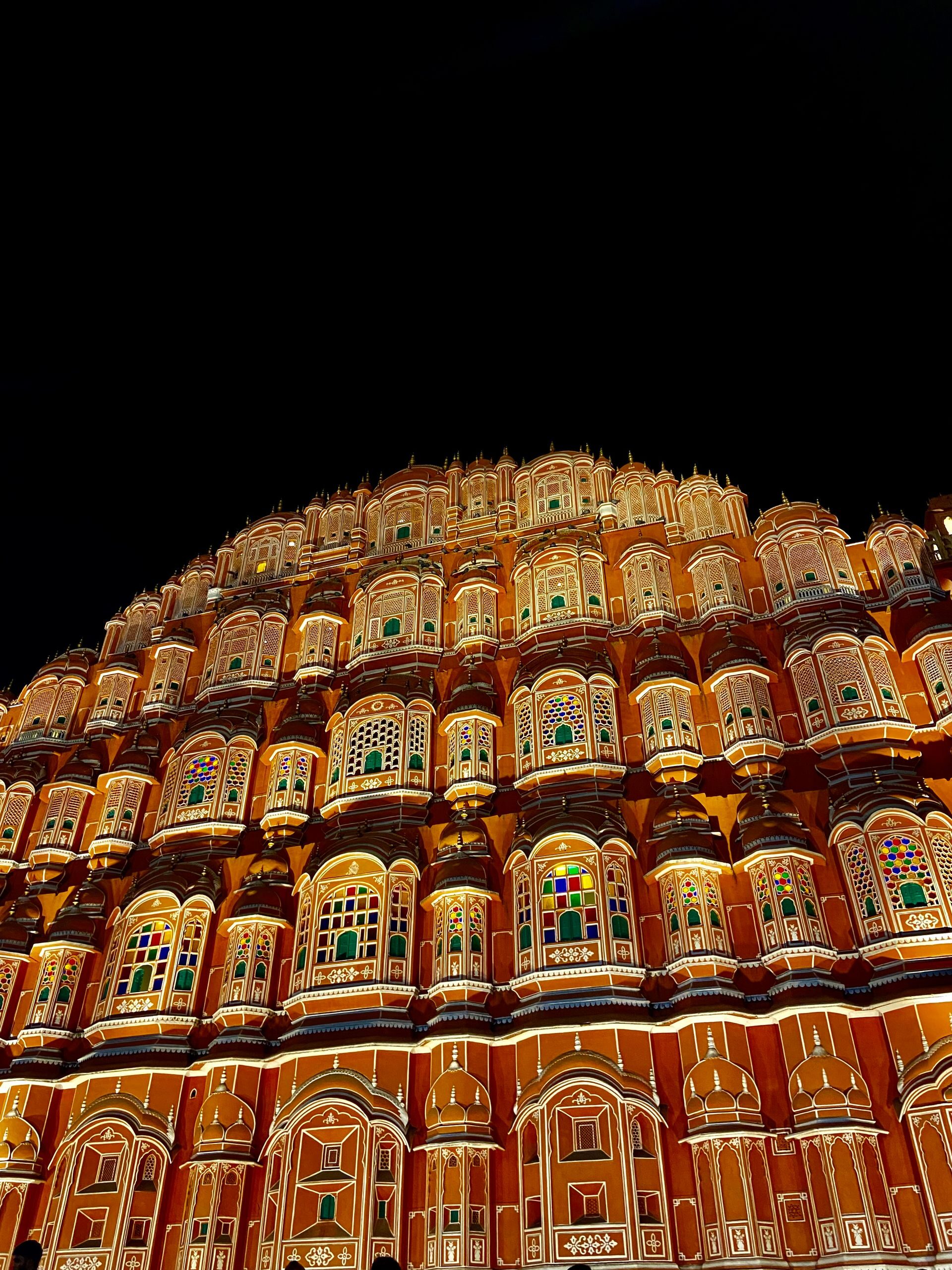
Most visitors see Jaipur between nine in the morning and five in the afternoon, which is the hottest, busiest and least flattering part of the day. Jaipur at night is a different city: the monuments are floodlit, the temperature drops by ten degrees or more, and the bazaars fill with people who live here rather than people visiting.
Here is what is actually worth doing after dark, and roughly when.
Hawa Mahal, lit
The Palace of Winds is the photograph everyone takes at eight in the morning, standing in traffic. After dark it is lit from below, the pink turns amber, and the pavement opposite is far emptier. Between about seven and nine is the sweet spot.
The view from Nahargarh
Nahargarh Fort sits on the ridge above the city. From the wall you can see the whole grid Jai Singh II laid out in 1727, picked out in street lights, with the old city glowing at the centre. The drive up takes about twenty five minutes from the centre and the road is narrow, so it is worth having a driver who knows it.
Sunset is the obvious time, and it is crowded. Arriving forty minutes after sunset usually gets you a quieter wall and better lights.
Amber Fort’s light and sound
Amber has an evening light and sound show in English and in Hindi, with the fort lit above the lake. It is not subtle, but the setting does most of the work. If you have already seen Amber in daylight on the Amber Fort and stepwells tour, the evening version is a genuinely different experience rather than a repeat.
Night markets and bazaars
The old city bazaars stay open late, and they are more pleasant at nine than at two. Johari Bazaar for jewellery, Bapu Bazaar for textiles and juttis, Tripolia for brass and lac bangles. Prices are the same as during the day; the crowd is more local. What to buy, and what a fair price looks like, is covered in shopping in Jaipur.
Where the food is
Evening is when Jaipur eats properly. Fried snacks from early evening, kulfi and lassi later, and rooftop restaurants around the old city with a view of the lit walls. If you want to know what to order, what to eat in Jaipur goes through the dishes that are actually local rather than the ones on every hotel menu.
Jal Mahal after dark
The water palace on Man Sagar Lake is floodlit and reflects almost perfectly on a still night. You cannot go in, and you do not need to. It is a five minute stop on the way back from Nahargarh or Amber.
Practical notes
- Monuments themselves close in the late afternoon. Evening is for exteriors, markets, food and views, not for interiors.
- Traffic in the old city is heaviest between six and eight. If you can start at seven thirty, you will move more easily.
- Women travelling alone generally find the main bazaars comfortable in the evening; quieter lanes less so.
- Bring a light layer between November and February. Jaipur nights are genuinely cold in winter.
- A tripod or a steady surface makes a large difference to photographs. Floodlit sandstone is forgiving.
Making an evening of it
If you would rather not work out the order or negotiate the traffic, the Jaipur by night tour is built exactly around this: the lit monuments, a stop or two for food, and the view from the ridge, with a car that waits for you. It pairs well with a daytime sunrise photography walk if you want the city at both ends of the light and nothing in the heat of the middle.
And if you are planning the whole day rather than just the evening, one day in Jaipur: the order that actually works sets out the sequence we use.