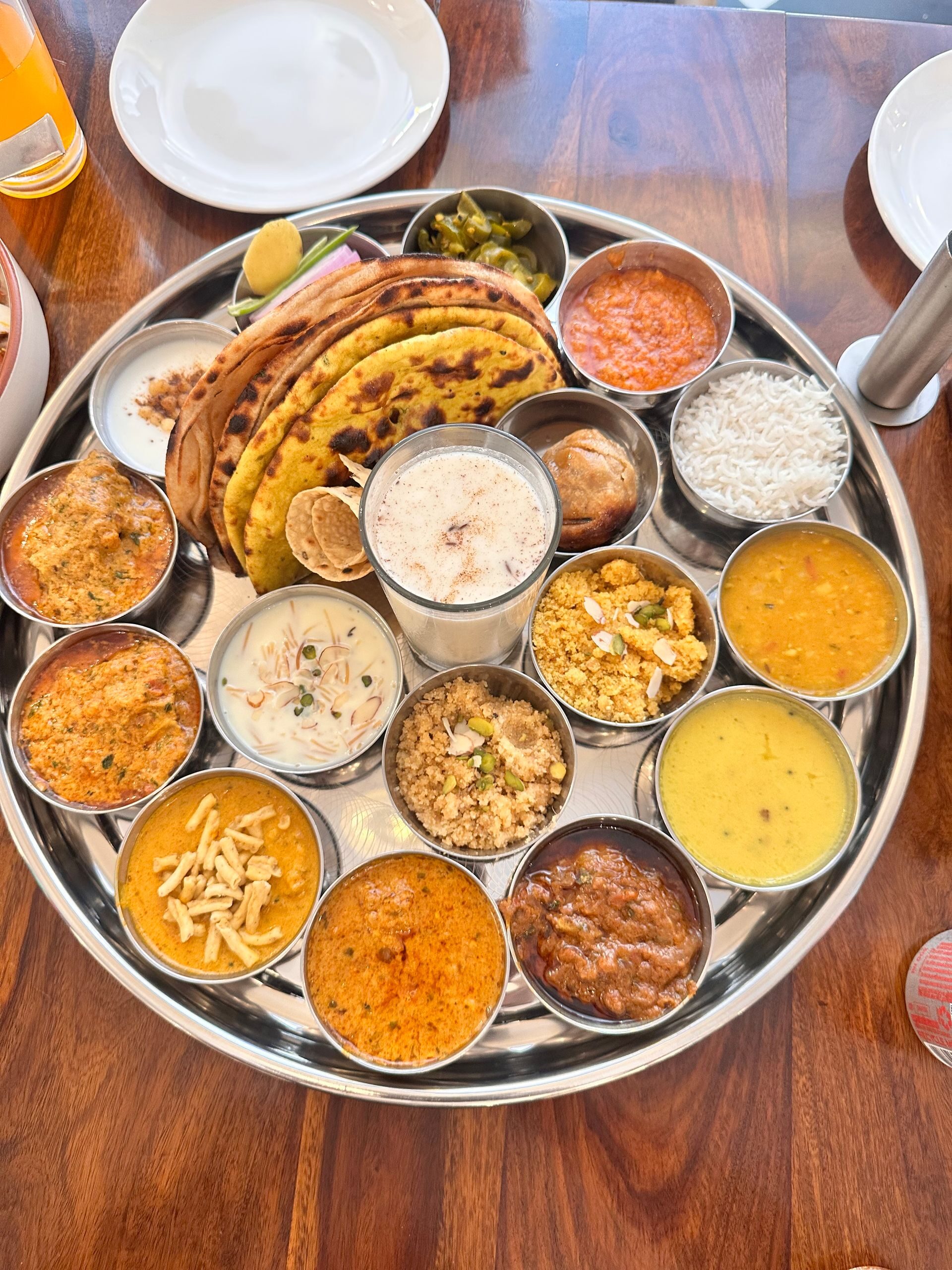
If you are wondering what to eat in Jaipur, the honest answer is that the city has two food cultures running side by side. There is Rajasthani home cooking, which is built around a desert with very little fresh vegetable supply, and there is Jaipur street food, which is fried, sweet and eaten standing up. Both are worth your time, and neither needs to make you ill if you use a little judgement.
This guide is written by people who drive visitors around Jaipur every week, so it leans on what our travellers actually finish rather than what looks good in a photograph.
Dal baati churma, the dish Rajasthan is known for
Baati are hard wheat rolls baked in ash or an oven, cracked open and drowned in ghee. They come with dal and with churma, the same dough crumbled with sugar and more ghee. It is heavy, and it is meant to be. Eat it at lunch, not at ten at night, and share one plate between two people the first time.
Pyaaz kachori and mirchi bada
The classic Jaipur breakfast is a pyaaz kachori: a fried pastry filled with spiced onion, served crushed with chutney. Mirchi bada is a large mild chilli in gram flour batter. Both are made in volume from early morning, which is exactly what you want, because a high turnover stall is a safe stall. We usually stop at one on the way out of the city on the Jaipur in a day tour if the group is up early.
Laal maas, and what to order if you do not eat meat
Laal maas is mutton cooked with Mathania red chillies. It is hot in a clean, direct way rather than a creamy restaurant way. Ask for it mild if you are unsure, because most kitchens will adjust it.
Vegetarians are extremely well served in Jaipur. Gatte ki sabzi, ker sangri, besan chakki and papad ki sabzi are all traditional, all vegetarian, and all come from the same logic: a desert kitchen cooking with what keeps.
Sweets, lassi and the afternoon
Jaipur takes sugar seriously. Ghewar in the monsoon months, feeni in winter, and mawa kachori at any time. A thick lassi in a clay cup is the standard afternoon stop. Clay cups are single use, which makes them a safer bet than a glass.
Where to eat, and how we think about safety
We do not publish a list of restaurants, because lists go stale and because a guide who is paid to bring you somewhere is not giving you an opinion. That is the whole point of how commission tours work in India, and it applies to food as much as to shopping.
What we do instead is simple. Your guide will tell you which stalls near your route are busy that day, take you there, and eat with you. A few rules that have kept our travellers well for years:
- Eat where there is a queue of local people, not a queue of tour buses.
- Fried and just out of the pan is safer than sitting under a lamp.
- Peel your own fruit, and skip salads on the first two days.
- Bottled water with an intact seal, and clay or steel cups for lassi.
- Give yourself a day before trying street food if you have just flown in.
Fitting food into a day of sightseeing
Food works best as a break rather than an event. On the old city walking tour we stop two or three times in three hours, which is enough to taste six or seven things without a full meal. If you would rather eat in the evening, the Jaipur by night tour is built around the lit-up city and its food stalls, and it starts after the heat has gone.
If you have a whole day and want the forts as well, read one day in Jaipur: the order that actually works, which sets out the sequence that keeps you ahead of the crowds and still leaves time to eat properly.
The short version
Try dal baati churma once, at lunch. Have a pyaaz kachori for breakfast from a busy stall. Drink one lassi a day. Order laal maas mild if you eat meat, and gatte ki sabzi if you do not. Tell your guide what you cannot eat before the day starts, and they will plan the stops around it rather than around a commission.