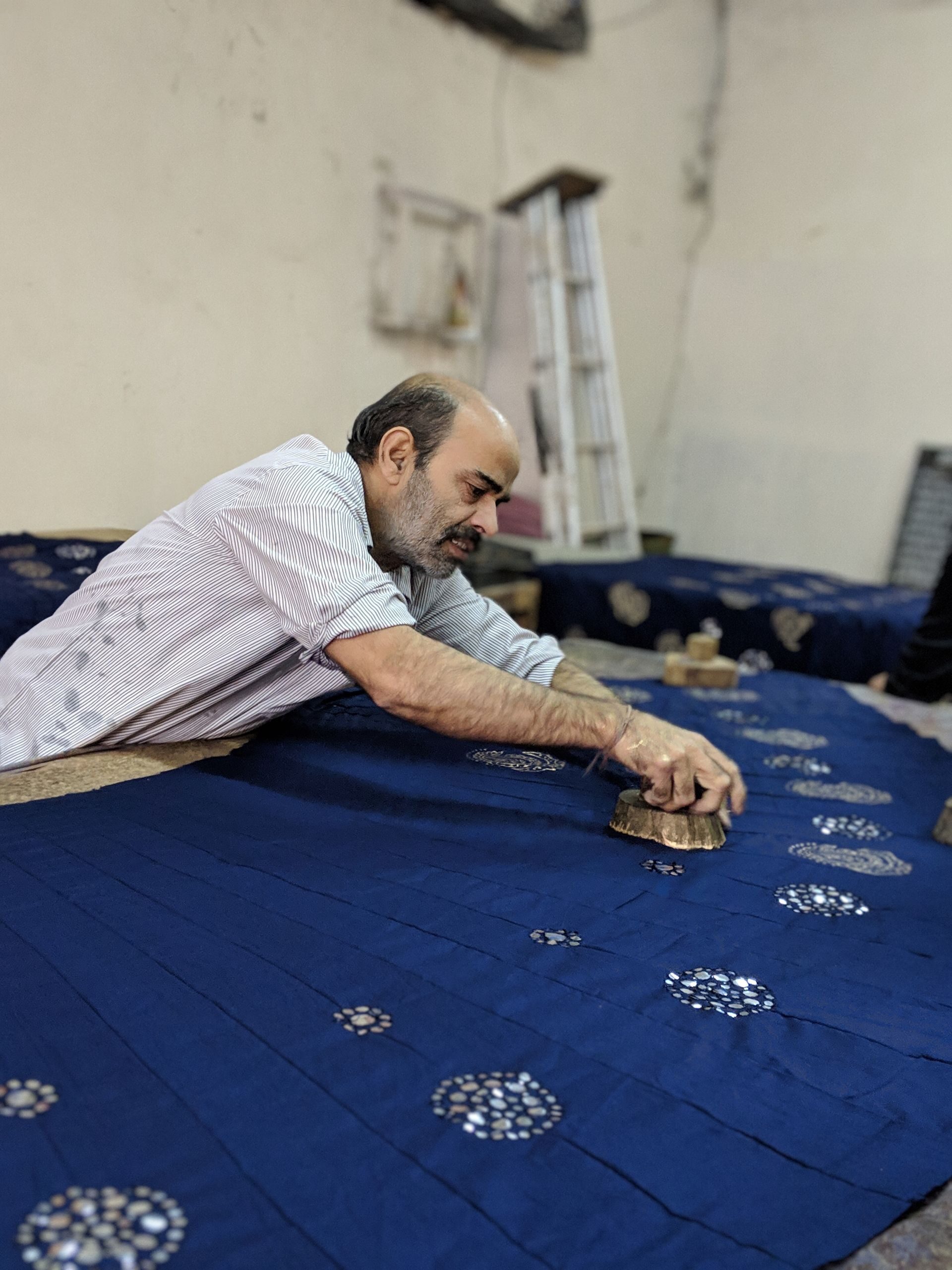
Shopping in Jaipur is genuinely good, and it is also the part of a Rajasthan trip where visitors most often feel they were handled rather than helped. Both things are true at once. The city has real craft traditions that are several centuries old, and it has an industry built around driving tourists to shops that pay a cut.
This is what is worth buying, roughly what it should cost, and how to tell the difference.
Hand block printed textiles
Block printing is the craft Jaipur is best known for, and most of it happens in Sanganer and Bagru, just outside the city. A carved wooden block, natural or pigment dye, and a printer working down a length of cloth by eye.
Signs you are looking at real hand block print: slight irregularities where the block was re-inked, a faint join line where one impression meets the next, and colour that has soaked through rather than sitting on the surface. Screen printed cloth is perfectly even, which is exactly how you spot it.
A simple cotton block print bedsheet or tablecloth is inexpensive. Fine work on silk, or a piece using several blocks and multiple dye baths, costs many times that, and should.
Gemstones: be careful
Jaipur is one of the world’s largest gemstone cutting centres, so the trade is real. The scam attached to it is also real and very old: a traveller is told they can buy stones here and sell them at a profit at home, sometimes with a story about customs or a partner abroad. There is no profit. Do not buy gemstones as an investment, ever, and do not carry stones for anyone.
Buying a stone or a piece of jewellery because you like it is fine. Ask for a certificate from a recognised laboratory, pay by card where you can, and keep the receipt.
Blue pottery, juttis and brass
Blue pottery is a Jaipur speciality, made from quartz rather than clay, glazed in cobalt and turquoise. It is fragile, so buy it last and pack it in clothes.
Juttis are the flat leather slippers you will see everywhere. Embroidered ones are cheap and sized approximately, so try both feet.
Brass and enamel work, marble inlay and miniature painting are all made in the city and all vary wildly in quality. Look at four before you buy one.
How commission actually works
A driver or guide who takes you to a shop is usually paid between twenty and forty per cent of whatever you spend. That money is not absorbed by the shop, it is added to your price, so the same scarf costs you more there than it does two streets away. Long, unplanned “workshop demonstrations” in the middle of a sightseeing day are the visible symptom.
We wrote about this in more detail in how to spot a commission tour in India. On our own days out, nobody is paid to steer your afternoon: if you want to see a block printing workshop we will take you to one, and if you do not, we will not mention it.
Bargaining without the theatre
In the bazaars around Johari Bazaar and Tripolia, prices are flexible and a polite negotiation is normal. In fixed price emporiums and government outlets they are not. A reasonable approach is to ask the price, offer about sixty per cent of it, and settle somewhere in the middle. If you are shopping on the old city walking tour, your guide will tell you which shops are fixed price before you start.
Getting it home
Shops will offer to ship. Small, reputable shops usually do this properly, but you have very little recourse from another country. If the item fits in your luggage, take it with you. If it does not, pay by card and get the shipping terms in writing.
Where shopping fits into a trip
Shopping and sightseeing do not mix well in the same three hours: the forts are best early, the bazaars are best late afternoon when the heat drops. If you are working out how to sequence a day, one day in Jaipur explains the order we use. For an evening that is mostly markets and food rather than monuments, the Jaipur by night tour covers it, and a car and driver for the day is the easiest way to shop across several districts without carrying bags in the sun.