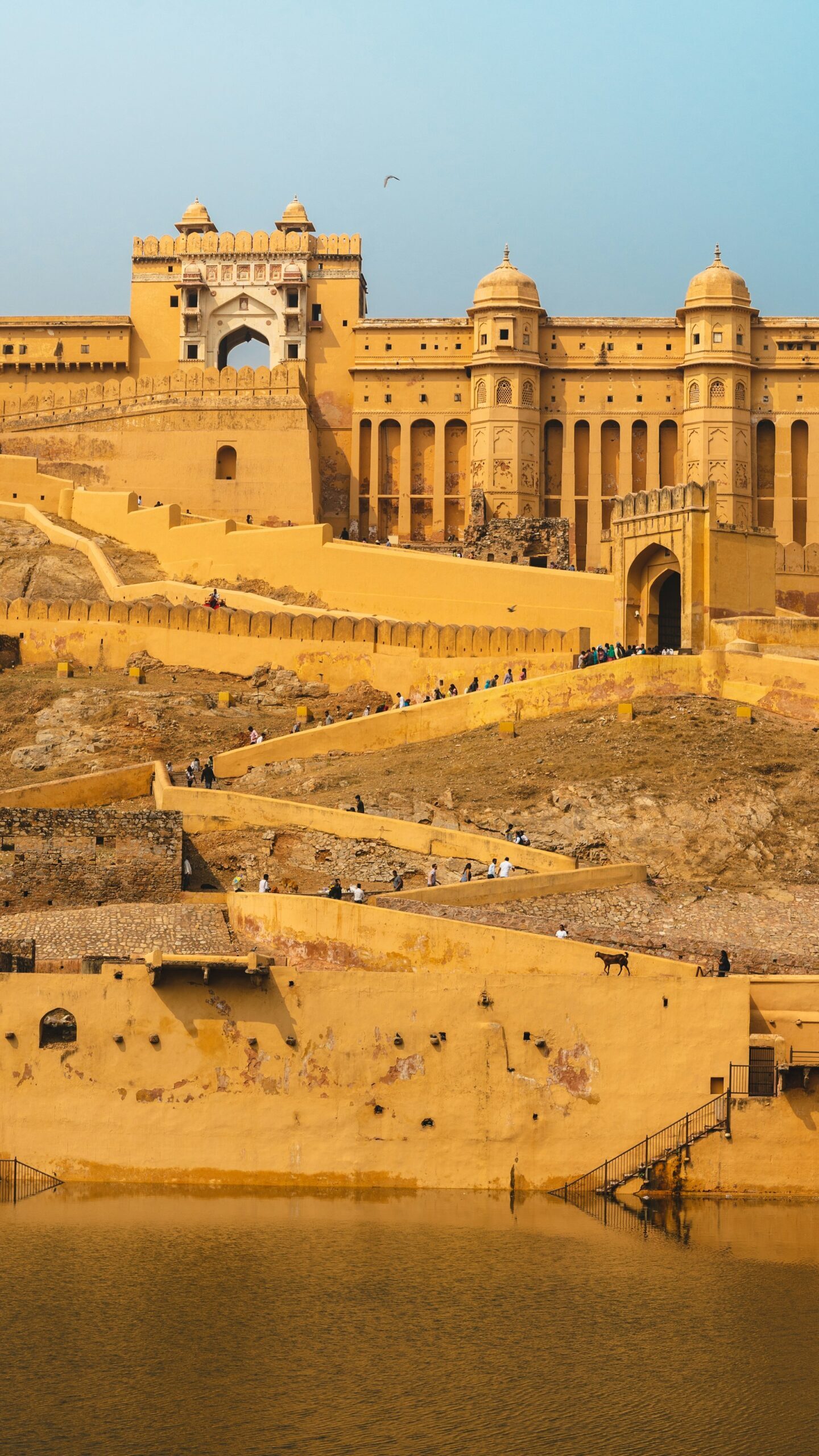
Amber is four courtyards on a hillside, built over about a hundred and fifty years, and most visitors see the first two and a half. Here is a route that fits three hours and takes in the parts that make it worth the climb.
Getting up there
Three ways: on foot up the cobbled ramp, by jeep, or by elephant. The walk is about fifteen minutes and is genuinely pleasant early in the day. The jeep is quick. We do not arrange elephant rides — the welfare questions around them are unresolved and we would rather not be part of it.
Arrive at eight, when it opens. Not half past nine. The difference in the Sheesh Mahal alone is worth the alarm.
Jaleb Chowk, the first courtyard
This is where the returning armies assembled. It is large, largely empty, and most people cross it in ninety seconds. Stop at the far end and look back at the wall running up over the ridge — that is the fortification line connecting Amber to Jaigarh above, and it tells you what this place was for before it was beautiful.
Diwan-i-Aam, the second courtyard
The Hall of Public Audience: a raised platform, double rows of columns, elephant capitals. Look up at the capitals rather than out at the view. Then the Ganesh Pol, which is the gateway everyone photographs, and correctly — the frescoed facade above it is the best-preserved painted surface in the complex.
The third courtyard: Sheesh Mahal and Sukh Niwas
The mirror palace is the famous room and it deserves the fuss. It is also small, and by eleven it is a scrum. Early, with the light coming in at an angle, the ceiling does the thing it was built to do.
Directly opposite, and skipped by most of the tour groups, is Sukh Niwas — the pleasure hall, cooled by water running down a marble channel through the room and out into the garden. It is a seventeenth-century air-conditioning system and it worked. Stand in the doorway for a minute and you can still feel the draught it was designed to create.
The fourth courtyard, which almost nobody reaches
This is the zenana, where the women of the court lived: a ring of twelve apartments around a central courtyard, arranged so the maharaja could visit one without the others knowing. The rooms are plainer and largely unrestored, and it is the quietest part of the fort by a long way. It is also the part that makes Amber feel like somewhere people lived rather than a monument.
What to skip
- The light and sound show, unless you are staying in Jaipur specifically for an evening and have already seen the fort by day.
- The souvenir shops inside the second courtyard. Everything there is cheaper three kilometres down the hill.
- Jaigarh on the same morning, if you only have one day. It is a fine fort with an enormous cannon, and it will not get the attention it deserves as your second stop before lunch.
A licensed guide turns Amber from an hour of pretty rooms into a story about a family, which is the difference worth paying for. Our Amber tours run first thing in the morning for exactly the reasons above.